
Buckhurst Hill, IG9
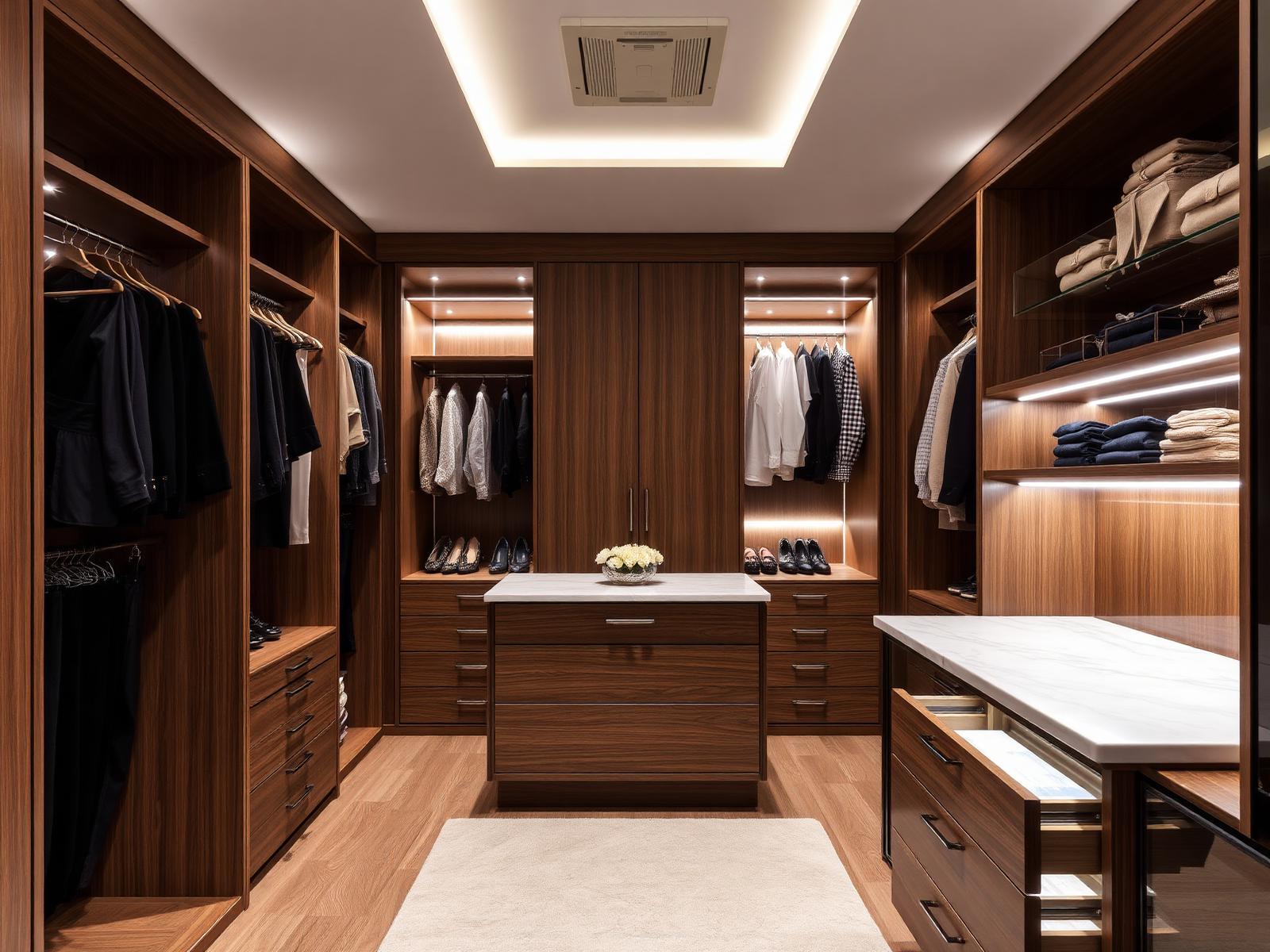
Loft master walk-in (U-shape) in walnut veneer with glass-front drawers, integrated LED strip lighting and a marble-topped dressing island.
Bespoke dressing rooms with hanging rails, glass-front drawers, shoe storage, integrated lighting and optional dressing islands — designed around your inventory and the room.
Free design visit · Integrated LED lighting · Written workmanship guarantee
A walk-in wardrobe is the upgrade that converts a small fourth bedroom, a generous landing or a loft eaves space into the most-used room in the house. Done well, it means clothes hung properly (long-hang for dresses, short-hang for shirts), drawers configured for actual inventory, shoes visible rather than piled, and integrated lighting that makes choosing an outfit pleasant rather than a fumble.
We design walk-ins around three patterns: U-shaped (the most common — three runs of cabinetry around three walls, walk-in entry), galley (two parallel runs facing each other, used for narrower rooms), and central island (a U-shape plus a freestanding cabinet in the middle, used where the room is generous enough). Internals are configured to your wardrobe inventory: long-hang vs short-hang ratios, drawer banks, pull-out shoe racks, integrated jewellery trays.
Most walk-ins are commissioned as part of a loft conversion or a master suite refurbishment. Where the joinery sits inside a freshly converted or plastered room, we coordinate directly with the build team so the carcasses install onto finished walls.
Part of our bespoke carpentry work across East London.
Walk-in wardrobes that disappoint usually fail at the design stage, not the build:
A walk-in wardrobe that doesn't suit how you actually dress is an expensive room you stop using. The detailing has to come from a real conversation about inventory and routine.
Five clear stages, typically 5–8 weeks from signed quote to install.
Free site survey, room measure-up, and an honest conversation about what you actually own — long-hang count, drawer capacity needed, shoe pairs.
Scaled plan and elevations, electrical schematic, fixed itemised quote — sign off before material is cut.
Concealed lighting cables and switching routed before joinery install.
Carcasses, doors, drawer fronts and any island built and finished in workshop. On-site install typically 5–8 days.
Walk-through, hardware adjustments, lighting calibration, written workmanship guarantee.
Long-hang vs short-hang ratio, drawer mix, shoe count — measured against what you actually own, not a generic split.
Recessed strip in every shelf and hanging run, switched on the door so it lights only the open carcass. Dimmable on a dedicated circuit.
Where space allows, a central island with stone top, drawers underneath and integrated jewellery trays adds a focal point and useful packing surface.
Carcasses in 18mm MDF or birch ply; soft-close hinges and runners (typically Blum) with lifetime mechanism warranty.
U-shape layouts run cabinetry around three walls with the walk-in entry on the fourth. Typical depths: 600mm for hanging runs (true 580mm internal, sized to standard hanger), 400mm for shoe runs and drawer banks. Centreline aisle ideally 1100mm minimum so two people can pass; 1400mm is more comfortable and lets you stand back to view a full outfit.
Galley layouts work in narrower rooms — two parallel runs of cabinetry facing each other across an aisle. Same dimensional rules apply: 600mm carcasses with 1100mm minimum aisle. Often used in converted small fourth bedrooms or generous landings.
Central island layouts (U-shape plus an island) need a room footprint of at least 3.5m × 3.0m to leave 900mm clearance around the island. Island typically 1200–1800mm long, 600mm deep, with 4–6 drawers and a stone top (quartz, marble or sintered stone offcut from a worktop project).
Internals matter more than door style here. Standard configuration: long-hang at 1100mm internal height (dresses, coats), short-hang at 850/850mm doubled (shirts, jackets), drawer banks in a mix of 100mm-150mm-200mm-250mm depths for trays, knitwear and folded items. Pull-out shoe racks (typically 4–6 pairs per shelf, 3–5 shelves per run), pull-out jewellery trays with felt linings, integrated trouser racks where requested.
Lighting is integrated, not surface. Standard spec: 2700K–3000K warm-white LED strip recessed in the underside of every shelf and hanging run, switched per cabinet on a magnetic door switch so the light comes on only when that carcass is open. Driver hidden in the carcass top; mains feed pre-routed at first-fix to a wall-plate switch and dimmer.
Walk-in wardrobes across East London and the Essex commuter belt — typical projects in South Woodford, Wanstead and Buckhurst Hill loft master suites, and across Walthamstow and Loughton master bedrooms repurposed from existing spare rooms.
Don't see your postcode? See every area we cover or ask us directly.
Founder & Lead Contractor, RJS Innovative Building Ltd
9+ years on East London building & fit-out projects · Companies House #10012712
Raphael leads walk-in wardrobe projects from the first design visit through install. The inventory audit at the design stage is what separates a walk-in that gets used from one that doesn't — and it's a conversation we run on every project.
Real East London projects — photographed on completion. Captions describe the actual work delivered.
Loft master walk-in (U-shape) in walnut veneer with glass-front drawers, integrated LED strip lighting and a marble-topped dressing island.
Spare bedroom converted to a galley walk-in in soft taupe with mirrored end wall and integrated jewellery trays.
Master suite walk-in with mixed-finish joinery (painted carcasses, oak-veneer interiors), pull-out shoe racks and trouser racks.
Free design visit and fixed written quote — usually within a week.
Free design visit · Integrated LED lighting · Written workmanship guarantee
Find us
RJS Innovative Building Ltd
47 Pulteney Road, South Woodford, London E18 1PR
Co. #10012712 · Founded 2016
Page details
Last updated: April 2026
Author: Raphael Sappa