
Single-storey vs double-storey extension — what's the difference?
The short answer
Choose single-storey when you only need ground-floor reconfiguration (kitchen-diner opening to garden) and value the simpler planning route. Choose double-storey when you also need additional bedrooms or an ensuite — the upstairs comes at only a small premium per m² because you're already paying for foundations, party walls and roof. Build time: single-storey 10–14 weeks on site, double-storey 14–20 weeks.
Single-storey extensions in detail
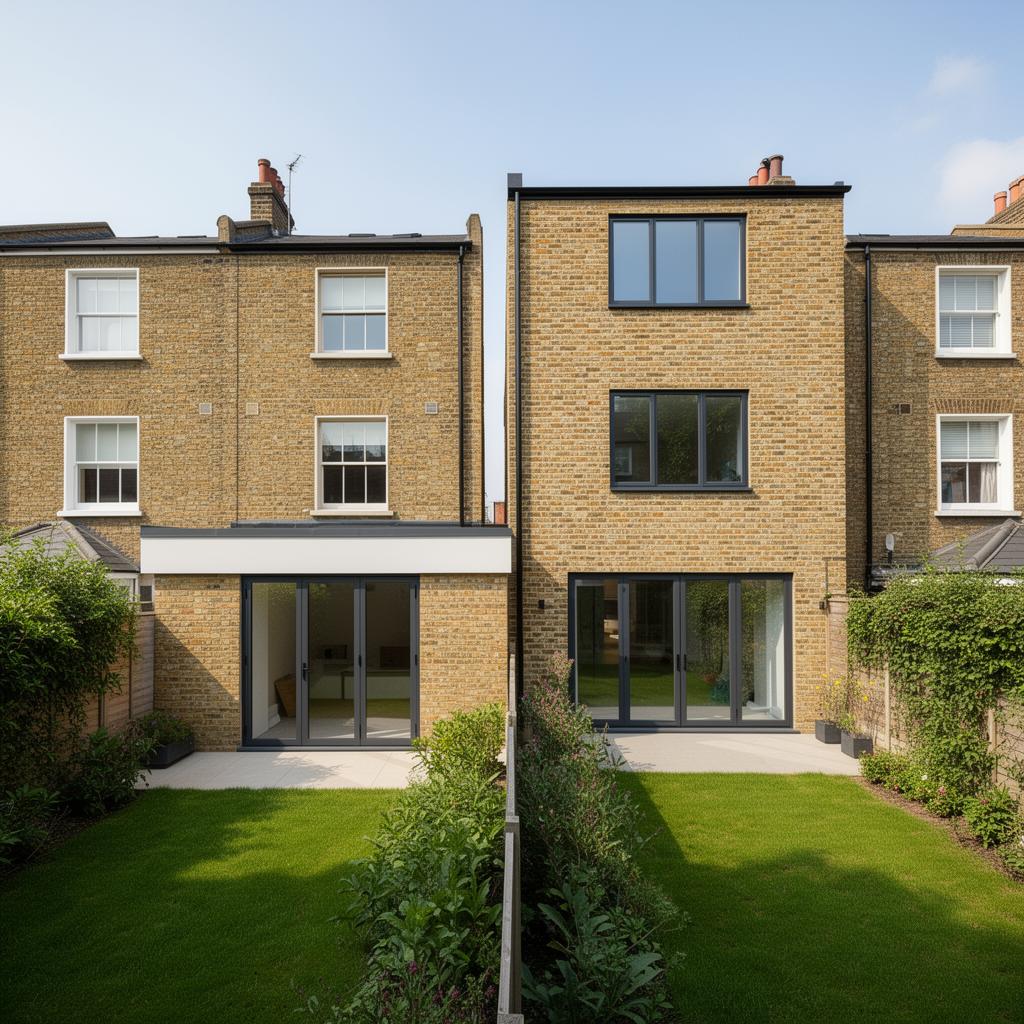
A single-storey rear or side-return extension adds living space to one floor, almost always the ground floor. The classic East London project is a 4m-deep rear extension on a Victorian terrace that turns a small original kitchen into a 25 m² kitchen-diner-living space opening to the garden through bifold or sliding glazing. Other common variants: side-return extensions that fill in the side alley alongside the back-addition wing, and wrap-around extensions that combine rear and side into a single L-shape.
Most single-storey rear extensions on terraces and semis fall under Permitted Development if they don't exceed 4m depth (detached) or 3m depth (terrace), 4m height, and use matching materials. That's a major time saving — Permitted Development applications via a Lawful Development Certificate typically clear in 8 weeks, vs 10–14 weeks for full planning, plus the certainty of approval. Conservation areas and Article 4 zones remove PD rights and require full planning regardless.
Build time on site is typically 10–14 weeks. Standard sequence: foundations (1–2 weeks), masonry shell and roof (3–4 weeks), glazing installation and weather-tight (1 week), first-fix M&E and plastering (3 weeks), finishes and second-fix (3–4 weeks).
For the full delivery scope, see see our full house extension service.
Double-storey extensions in detail
A double-storey extension stacks an upper floor on top of a ground-floor extension, adding both living space downstairs (typically the same kitchen-diner outcome) and one or two rooms upstairs (typically a bedroom plus ensuite or a master suite). The structural and foundation work is shared with the ground floor, which is exactly why the per-m² cost is only marginally higher than single-storey — you're getting two floors of usable space off one set of foundations and one Party Wall process.
Almost all double-storey extensions require full planning permission rather than Permitted Development. They almost always trigger Party Wall awards with both adjoining neighbours because the new wall and roof structure abuts both shared walls. Pre-construction time is typically 12–18 weeks vs 10–16 for single-storey.
Build time on site is 14–20 weeks. Standard sequence: deeper foundations sized for two-storey load (1.5–2 weeks), ground-floor masonry and floor zone (3 weeks), first-floor masonry and roof (3 weeks), windows and external finishes (1–2 weeks), first-fix M&E both floors (3–4 weeks), finishes both floors (5–6 weeks).
How it compares
Side-by-side comparison for a typical East London terrace project:
| Factor | Single-storey rear | Double-storey rear |
|---|---|---|
| Ground-floor space added | 18 – 25 m² | 18 – 25 m² |
| First-floor space added | None | 16 – 22 m² |
| Total usable space added | 18 – 25 m² | 34 – 47 m² |
| 2026 East London cost (typical) | ||
| Cost per m² (effective) | ||
| Planning route | Often Permitted Development | Almost always full planning |
| Build time on site | 10 – 14 weeks | 14 – 20 weeks |
| Best for | More living space, no bedroom shortage | More living space AND bedrooms |
| Value uplift in our catchment | 10 – 20% | 15 – 30% |
If you need bedrooms, double-storey is almost always the better value choice.
Edge cases — when single-storey wins, when double-storey wins, when neither is right
Single-storey wins when: you have enough bedrooms already (a loft conversion plus a single-storey rear is usually a better project mix than a double-storey rear if you don't need to add a bedroom downstairs), your rear neighbours are sensitive to overlooking from a new upstairs window (almost guaranteed to attract objections at planning), or your existing first-floor structure is fragile (some Victorian terraces would need significant structural underpinning before a double-storey extension can sit alongside).
Double-storey wins when: you need both more living space and more bedrooms, your budget can carry the higher absolute cost, and your borough's planning policy is open to double-storey rear projects (most East London boroughs are unless you're in a conservation area). It also wins on value-per-pound-spent — roughly twice the floor area for around 1.5x the build cost.
Neither is right when: you only need bedrooms (a loft conversion is much cheaper per m² and doesn't lose garden depth), your garden is so narrow that any rear extension would leave less than 7m of garden remaining (most boroughs resist extensions that leave under 7m of rear amenity space), or you're in a conservation area and the council has a published policy against rear extensions on your specific street.
If you'd rather skip the research and just talk through your project, see house extensions across East London.
About the author
Raphael Sappa
Founder & Lead Contractor, RJS Innovative Building Ltd
9+ years on East London building & fit-out projects
Raphael has built both single-storey and double-storey rear extensions across the full East London catchment since 2016, including double-storey projects in Loughton, Buckhurst Hill and South Woodford that combine kitchen-diner downstairs with master suite upstairs. Every project starts with a layout review of the whole house — because the right extension is rarely the one that adds the most square metres, it's the one that fixes the layout problem you actually have.
Related questions
Weighing single vs double-storey for your specific layout?
Free site visit and honest recommendation on which route fits your house, your budget and your borough's planning policy.
Which? Trusted Trader · Companies House #10012712