
Dormer vs hip-to-gable loft conversion — which suits your London home?
Choose a rear dormer if you have a Victorian or Edwardian terrace with a pitched rear roof — it's the cheapest route to a usable bedroom and ensuite.
The short answer
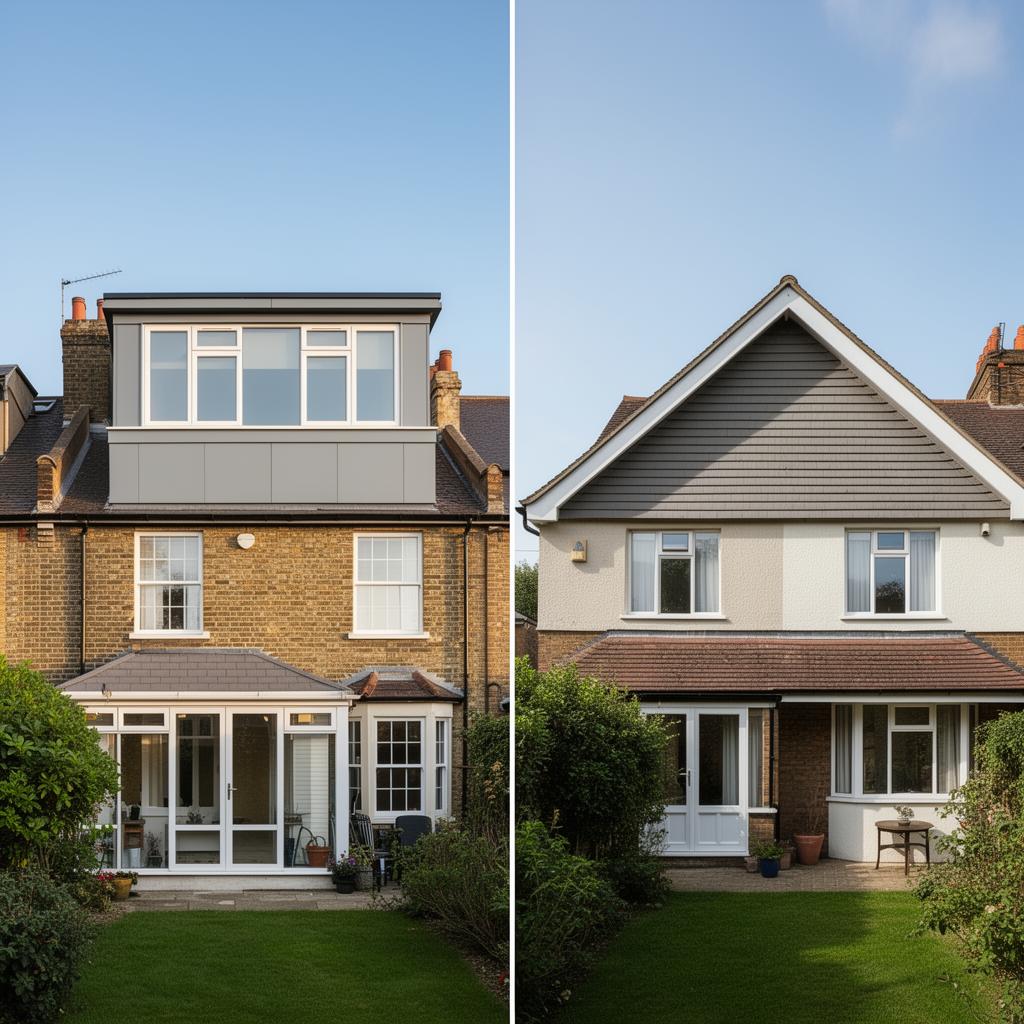
Rear dormer: best for Victorian and Edwardian terraces with a standard pitched rear roof slope. Hip-to-gable: best for 1930s semis and detached homes with a hipped (sloping) side roof. Rebuilds the side roof as a vertical gable wall, then adds a rear dormer on top. The right choice depends entirely on your roof type — you almost never have a real choice between the two.
What a dormer conversion actually is
A dormer is a structural extension that projects out from the existing roof slope, creating a vertical wall and a flat (or shallow-pitched) roof above. The internal effect is to convert the previously sloping ceiling area into full standing-height room — typically 2.3m to 2.4m head height where the dormer sits, with the original sloping ceiling preserved at the front of the room.
On a London Victorian or Edwardian terrace, the rear dormer is built off the existing rear roof slope, with structural steels carrying the new floor and dormer cheeks. The front of the loft (facing the street) typically keeps the original tile-clad sloping roof and gets two Velux windows for light. This is the workhorse East London loft conversion — used on the majority of terraced properties from Stratford up through Walthamstow, Leytonstone and South Woodford.
For the full delivery scope, see see our full loft conversion service.
What a hip-to-gable conversion actually is
Hip-to-gable applies to homes with a hipped roof — where the side roof slopes inward toward a ridge rather than terminating in a vertical brick gable wall. This is standard on 1930s semis, Edwardian end-of-terraces, and some inter-war detached stock — common throughout Chingford, Loughton, Buckhurst Hill and parts of Wanstead.
The conversion rebuilds the hipped side as a vertical gable wall in matching brick or render, dramatically increasing the internal volume of the loft. A rear dormer is then almost always added on top to give the new room full standing height across the rear half. The result is the largest single-room loft conversion you can build on a typical inter-war semi — often 25 m² or more of usable floor area, enough for a master bedroom, ensuite and built-in storage.
Hip-to-gable on a semi or end-of-terrace usually requires Party Wall awards with the adjoining property and the property next door. It also takes longer on site (10–12 weeks vs 8–10 for a straight dormer) because the side wall needs to be built up from existing wall plate level in matching brickwork before the dormer goes on.
How it compares
Side-by-side at-a-glance comparison:
| Factor | Rear dormer | Hip-to-gable + dormer |
|---|---|---|
| Best for | Victorian / Edwardian terraces | 1930s semis, end-of-terraces, hipped detached |
| Usable floor added | 12 – 18 m² | 20 – 28 m² |
| Typical cost (2026, East London) | ||
| Time on site | 8 – 10 weeks | 10 – 12 weeks |
| Planning route | Often Permitted Development | Often Permitted Development on semis |
| Party Wall notices | Both adjoining neighbours | Adjoining neighbour + side neighbour |
| Ideal layout outcome | Bedroom + ensuite | Master suite with dressing area |
In practice, your roof shape decides for you. If you have a flat brick gable wall on the side, your route is a dormer. If your side roof slopes inward to the ridge, your route is hip-to-gable + dormer.
When to combine, when to upgrade, and when neither works
The L-shape conversion is a third option worth knowing about: a rear dormer combined with a second dormer over the existing rear outrigger (the back-addition wing common on Victorian terraces). It delivers the largest loft conversion possible on a terrace — a master suite plus a small second room or office — but typically pushes you over the 40 m³ Permitted Development cap and into full planning, which adds 8–14 weeks of pre-construction.
They're typical in premium Hackney, Stratford and Walthamstow projects where the value uplift justifies the cost and where conservation area constraints have already required design-led planning.
Neither dormer nor hip-to-gable works if your existing roof ridge is too low — anything under about 2.3m of head height at the ridge means you'd be left with a room that feels cramped even with a dormer. In those cases the only path to full standing-height loft space is a roof raise (relatively rare and usually requires full planning) or accepting a smaller usable area.
If you'd rather skip the research and just talk through your project, see loft conversions across East London.
About the author
Raphael Sappa
Founder & Lead Contractor, RJS Innovative Building Ltd
9+ years on East London building & fit-out projects
Raphael has converted lofts on every common East London roof type — from Hackney Victorian terraces to Buckhurst Hill 1930s semis to Loughton inter-war detached. Each site visit starts with a ridge-height measurement and a roof-type assessment, so the recommendation is grounded in what's structurally possible at your specific property rather than what's most profitable to build.
Related questions
Not sure which conversion type your roof can take? Free site visit settles it.
30-minute visit, ridge-height check, type recommendation and indicative budget — no pressure to proceed.
Which? Trusted Trader · Companies House #10012712