
Loughton, IG10
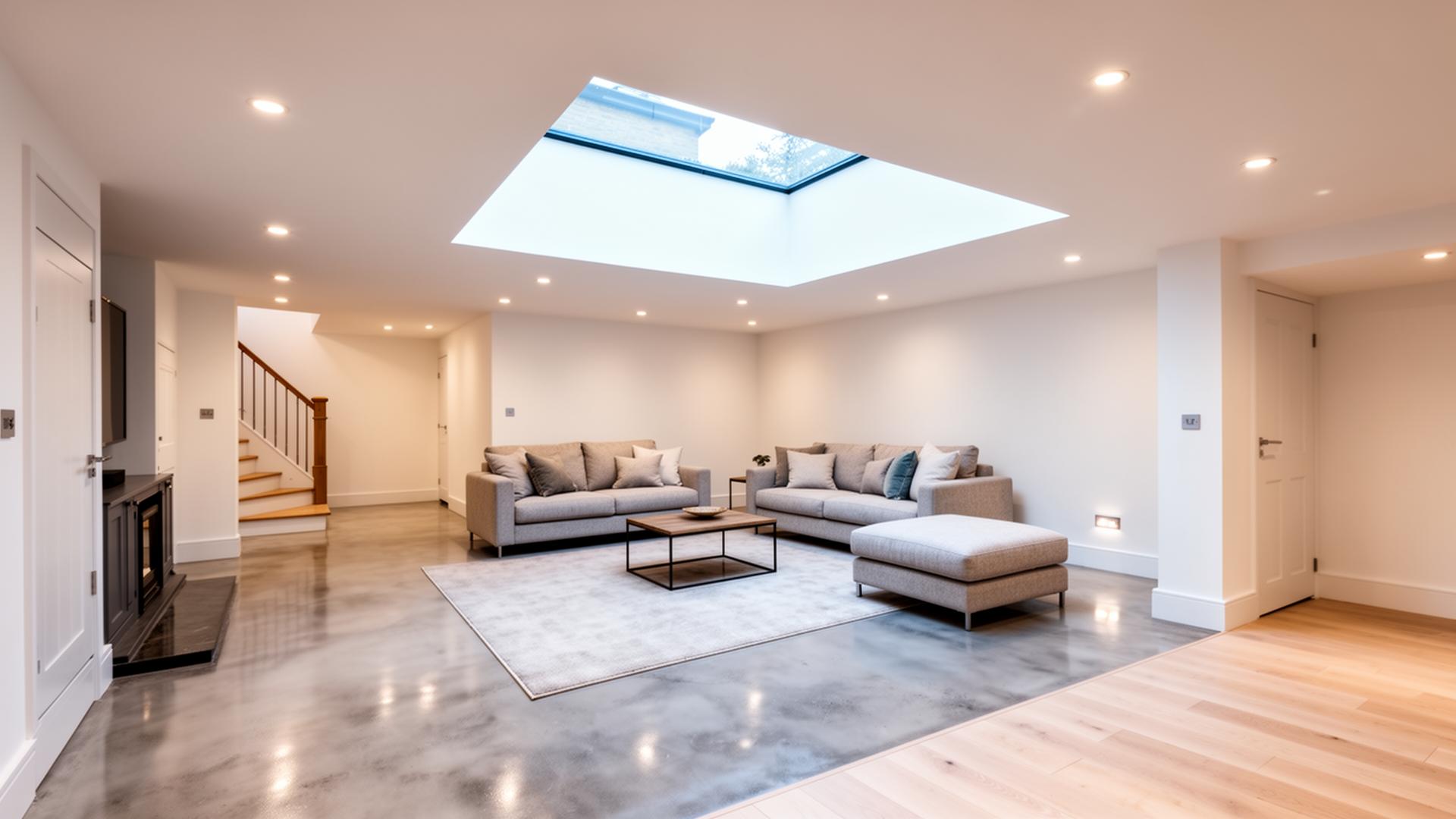
Full underpinning of existing cellar lowered floor by 700mm to achieve 2.5m head height; converted to home cinema and gym, 22 weeks on site.
Add a usable storey without losing your garden or street footprint — cellar conversion to full underpinning, designed and built to BS 8102 standards.
Specialist work · Quoted properly, not under-spec'd · Structural engineer-led
Basement work is the most technically demanding category we run. Done properly, it adds a fully habitable storey — typically 30–50 m² of new floor area — without changing the visible footprint of your house. Done wrong, it floods, undermines the existing structure, or fails Building Regs and stays unusable.
We deliver three distinct types of basement project. Cellar conversions: where there's already a usable below-ground volume that needs damp-proofing, lighting and finishing. Underpinning: lowering an existing cellar floor to achieve full habitable head height (minimum 2.4m), which involves sequenced excavation under the existing walls and casting new structural foundations. Full basement digs: excavating an entirely new below-ground room under a house with no existing cellar — the most complex and expensive option, almost always requiring full planning and structural engineer sign-off at every stage.
Most basement clients are owner-occupiers in larger Edwardian and inter-war stock in Hackney, Wanstead, Loughton and Buckhurst Hill, where plot footprints are already maximised above ground. Typical end uses: home cinema, gym, second living room, guest suite with ensuite, or self-contained annexe. We always work to BS 8102 Grade 3 (suitable for habitable use) using Type A (barrier waterproofing), Type B (integral structural waterproofing) or Type C (cavity drain membrane with sump and pump) — usually a combination depending on water table and structural detail.
Part of our building & conversions work across East London.
Basement failures are catastrophic and expensive. The common ones are all design-stage decisions:
Basement remediation typically costs 2–4× the original build budget and almost always requires the basement to be empty for 6+ months. Many failures are uninsured because the original spec didn't comply with BS 8102 — the insurer treats it as a defect, not a peril.
Six stages, with structural engineer sign-off at the end of every excavation phase. No corners cut.
We assess existing cellar (if any), water table, party walls, neighbour structures and access. You get an honest answer on whether the project is viable and roughly what it costs.
Architect's drawings, structural engineer's calcs for underpinning sequence and waterproofing system, full planning application, Party Wall Act notices and awards.
Itemised against the structural design — every excavation bay, waterproofing layer, drainage component and finish costed.
Sequenced bay excavation, structural concrete pours, party wall management. Engineer signs off each phase before the next bay opens.
Type A barrier coatings, Type C cavity drain membrane, sump and pump installation, insulation, framing, M&E first-fix, plastering and finishes.
Building Control completion, insurance-backed waterproofing warranty (where applicable), snag walk-through, written workmanship guarantee.
Combined Type A and Type C systems sized for actual water table conditions — the only spec considered safe for habitable basement use.
Underpinning calcs, sequencing and bay sign-offs by a chartered structural engineer — not a builder making it up as they go.
Twin-pump systems with battery-backed alarms, so a power cut during heavy rain doesn't become a flood.
On qualifying waterproofing systems — gives you something to claim against if a leak ever develops.
Underpinning is the controlled, sequenced excavation of small sections (typically 1–1.2m wide bays) under existing load-bearing walls, casting new structural concrete foundations beneath each bay before moving to the next. The sequence — alternating bays, leaving piers undisturbed — is critical: dig adjacent bays simultaneously and the wall above can drop, cracking the structure. A structural engineer designs the sequence and signs off each bay before the next opens.
Type A waterproofing is a barrier system: cementitious slurry coatings or bitumen membranes applied to the inside or outside of the structural wall. Cheap and simple, but the only thing keeping water out is the barrier itself — any breach means a leak.
Type B is integral structural waterproofing: the concrete itself is mixed and detailed to be water-resistant (using waterstops at construction joints, hydrophilic strips, and admixtures). Used most often in new-build basements and full digs, less in retrofit.
Type C is cavity drain membrane: a dimpled HDPE membrane is fixed to the inside of the wall, creating a small cavity behind a finished wall surface. Any water penetrating the structural wall runs down the cavity to a perimeter drainage channel and into a sump, where pumps discharge it. The wall finish stays dry even if the structural wall is wet.
BS 8102:2022 Grade 3 — required for habitable basement space — requires the waterproofing system to keep the internal environment dry and humidity-controlled. In practice, almost every East London retrofit basement combines Type A (cementitious tanking on the structural wall) with Type C (cavity drain membrane behind the finishes), giving two independent layers of defence. Sumps must have twin pumps with battery-backed alarms.
Most of our basement work has been in larger Edwardian and inter-war properties in Loughton, Buckhurst Hill, Hackney and Wanstead — homes where the above-ground footprint is already maximised and the only direction left is down.
Don't see your postcode? See every area we cover or ask us directly.
Founder & Lead Contractor, RJS Innovative Building Ltd
9+ years on East London building & fit-out projects · Companies House #10012712
Raphael has run more than 20 basement and cellar projects across East London — predominantly Type C cavity drain conversions in Hackney terraces and full underpinning in Loughton and Buckhurst Hill. He works with the same chartered structural engineer on every basement project for sequencing sign-off.
Real East London projects — photographed on completion. Captions describe the actual work delivered.
Full underpinning of existing cellar lowered floor by 700mm to achieve 2.5m head height; converted to home cinema and gym, 22 weeks on site.
Cellar conversion with Type C cavity drain system and twin sump pumps, finished as guest suite with ensuite.
New basement dig under existing footprint adding 38m² of habitable space across two rooms.
Free site visit and an honest assessment of feasibility, water table risk and realistic budget.
Specialist work · Quoted properly, not under-spec'd · Structural engineer-led
Find us
RJS Innovative Building Ltd
47 Pulteney Road, South Woodford, London E18 1PR
Co. #10012712 · Founded 2016
Page details
Last updated: April 2026
Author: Raphael Sappa